|
The following is a poignant explanation of the Agnostic approach towards religious issues,
and a defense of its position even in the face of mortality.
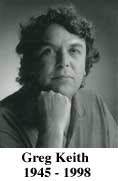
It was written by Greg Keith, a gifted poet in Santa Cruz, California who died of cancer in 1998. Prior to passing away, he maintained a Webpage on which he posted his observations on various issues as he faced his own mortality. He wrote this during his last few months, in response to some friends who had contacted him regarding whether he would reconsider his rejection of the Christian faith now that questions about the afterlife were becoming more immediately relevant. In this, he explains that he has not changed his outlook on religious questions even in the face of death, and goes on to very clearly spell out his reasons why. It is a very good example of applied Agnosticism. This is posted with permission from Greg, obtained by myself shortly after he wrote it.
|
|
Dear -- Thank you for your letter, the immunotherapy info, and for your prayers. I can feel the love behind them all and I want to hug you back. I do appreciate your reaching out. As you mention in one paragraph, there's a considerable risk in broaching the topics of death and religion. And the risks are real, not just a breach of social convention, but an exposure of our inmost vulnerability. The knowledge of mortality challenges each of us and we each come to our own terms with it, or fail to - we can die whether we're at peace with it or not. And, of course, one of the big functions of religion is to help people make that peace. In all honesty, though, I have to say I can't embrace the Christian message. I grew up in the Southern Baptist church and my family is well supplied with preachers, missionaries, and fervent believers. The quotations from the Epistles are familiar to me. I have re-read much of the Bible as an adult, both the New and the Old Testaments, so it's not for lack of exposure to the imagery that I have failed to take the message to heart. I have a similar inability to take up the thread offered by my New Age friends when they cheerfully talk about reincarnation, as if it were clear what that might mean. To even pose the question of "what happens to me after I die" I would have to imagine that "I" am made of some special substance, as if the body were a rough glove and the soul a subtle hand that could slip out of it. Now, of course, I can imagine that, and I must admit that I can't disprove it, but I find no necessity for believing it. I have to just shrug, don't know. On the other hand it's hard not to believe that sensation and cognitive process depend directly on neural activity -- if no optic nerves, then no vision, if no frontal cortex, then no long term planning. I don't think there's a little guy inside doing the watching. In my view the "I" is a construct and a useful fiction, not false exactly, but an epiphenomenon like the focal point of binocular vision. Like visual focus, the point of experiential focus moves now here, now there, but it's not a thing, not the tip of a stick, not a spot in the world nor a place in the brain, but a process, more like a habit or a style than like a hand inside the flesh puppet. Or, despite the massive parallelism of the brain, say the "I" is roughly like the point of execution in running code, the ego just an Instruction Pointer, next, next, next. What about deeper levels of selfhood? What is character made of? The Will? Surely love comes not from ego but from some center deserving the name spirit or soul. As far as I can tell, there is only matter and material relationships, or structure. Matter and info, things and meanings, and these seem inextricable. I see no hint of some other "stuff" for "spirit" to be made of, so I work with the assumption that "spiritual" refers to a kind of meaning and that "soul" is likewise a level of integration on the info/meaning side of our description of the universe, not a coin to be either deposited in Jehovah's piggybank or tossed into the bottom of Satan's change drawer. The last four centuries have held big surprises about just how subtle and complex is the matter our bodies are made of, whether that subtlety is quantum mechanical or biochemical. Any separable soul inhabiting such an intricate temple would have to be just as subtle and surprising merely in order to maintain an interface. Even without the difficulty of imagining what kind of "stuff" a soul might be made of, by the time I pare away the cognitive and emotional capacities that are demonstrably dependent on intact neural structures there is nothing that is clearly "Greg" left to survive the body. I don't find this worrisome. At times I fear dying but I don't fear being dead. My intervention was not required for me to come into existence and my vanishing, leaving only spreading ripples on the social pond behind me, seems just fine to me - even the sadness and grief of friends and family are just part of that rippling. I believe that my apparent separateness is analogous to an eddy in water or a whirlwind in air. These are real "things" in one sense, the structure of the whirlpool persists in place as the water moves through it and something very Greg-like persists as materials and information and meanings course through me. When a whirlpool collapses or a whirlwind dissipates we feel no need to explain where "it" went. To my mind the idea that I am what the universe feels like inside is obvious on the face of it, both a superficial fact and a deeply magical truth. It also allows the universe to feel like the insides of other people and whales and squid and paramecia. How much of an inside a rock has to be feeling like anything remains an open question, but that minerals, say calcium or lithium, can participate in feeling is clear. This view makes the material world much more mysterious and wonderful than what I call Casper the Ghost scenarios in which some ectoplasm is what matters and matter is disdained. Some people claim to actually remember past lives, and these are routine assertions in Mahayana Buddhist and Advaita Vedanta traditions, which I respect for numerous other insights. But I just have to shrug again, I don't know. I don't remember past lives and don't know what it would mean to have had any. My not knowing proves nothing, of course, any more than my believing something makes it true. I refuse to understate my own ignorance. Ignorance seems vast, big enough for all six billion of us to write all our beliefs on without even smudging its blank expanse. Greg |